
Privacy by Design: Creating Secluded Outdoor
Spaces That Feel Open, Not Boxed In
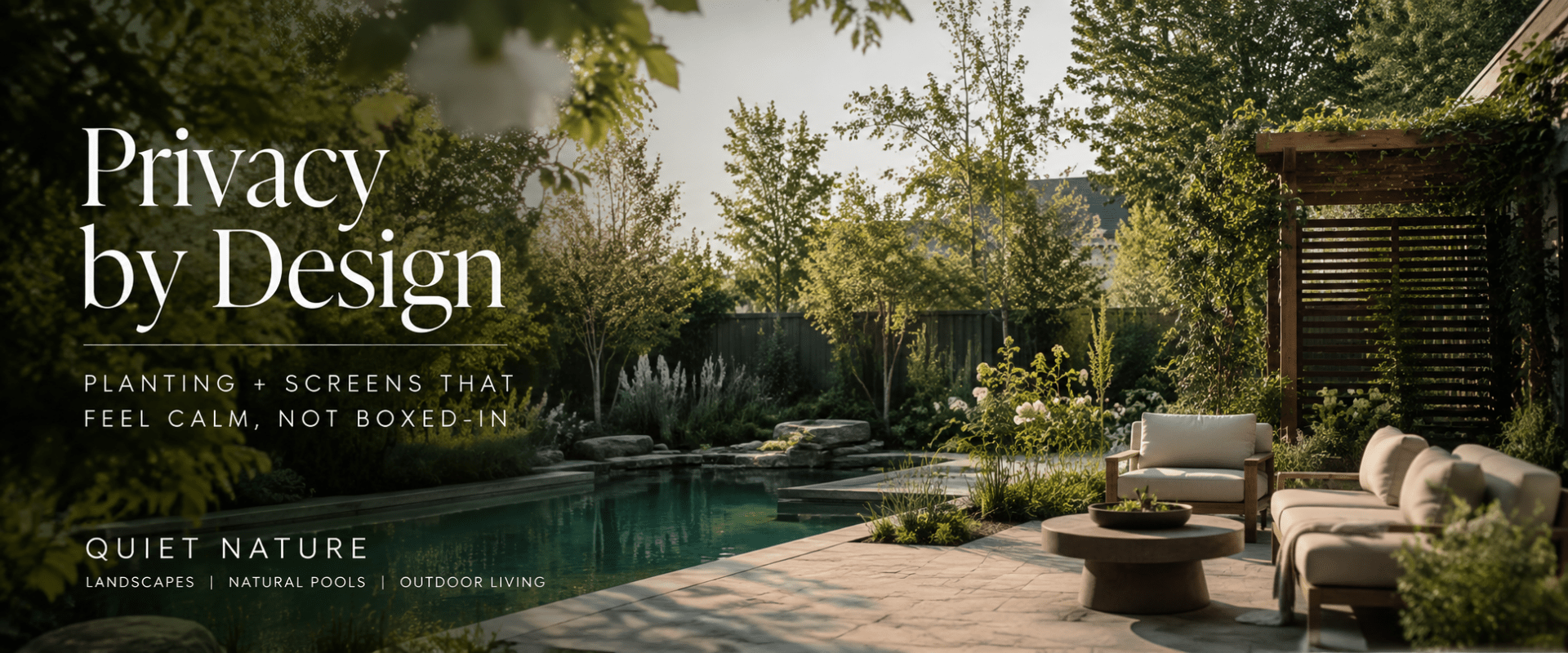
There’s a quiet kind of luxury that doesn’t shout for attention. It’s the feeling of stepping into your backyard and exhaling—fully.
No sightlines from neighboring windows. No sense of being watched. Just space that feels entirely yours.
But here’s the tension many homeowners face: how do you create privacy without making your yard feel closed off, heavy, or confined?
Too often, privacy is treated as a problem to solve with height—taller fences, thicker hedges, solid screens. The result? S
paces that technically block views, but also block light, air, and the sense of openness that makes a garden feel alive.
At Quiet Nature, we approach privacy differently. Not as a barrier, but as a layered, intentional experience. Privacy by design means
creating subtle separation while preserving softness, movement, and connection to nature. This is how outdoor spaces become both protected and expansive.
Rethinking Privacy: From Barriers to Layers
Traditional privacy solutions tend to rely on single elements—one fence, one hedge, one wall.
The issue is that singular solutions often feel abrupt. They draw a hard line between “inside” and “outside,” which can make a space feel smaller than it is.
Layered privacy, on the other hand, works with depth.
Instead of one solid obstruction, multiple elements are arranged to partially obscure views from different angles. This creates:
- A softer visual boundary
- A sense of depth and dimension
- A more natural, immersive environment
Think of it less like building a wall—and more like composing a landscape.
What Layering Can Look Like
A thoughtfully designed backyard might include:
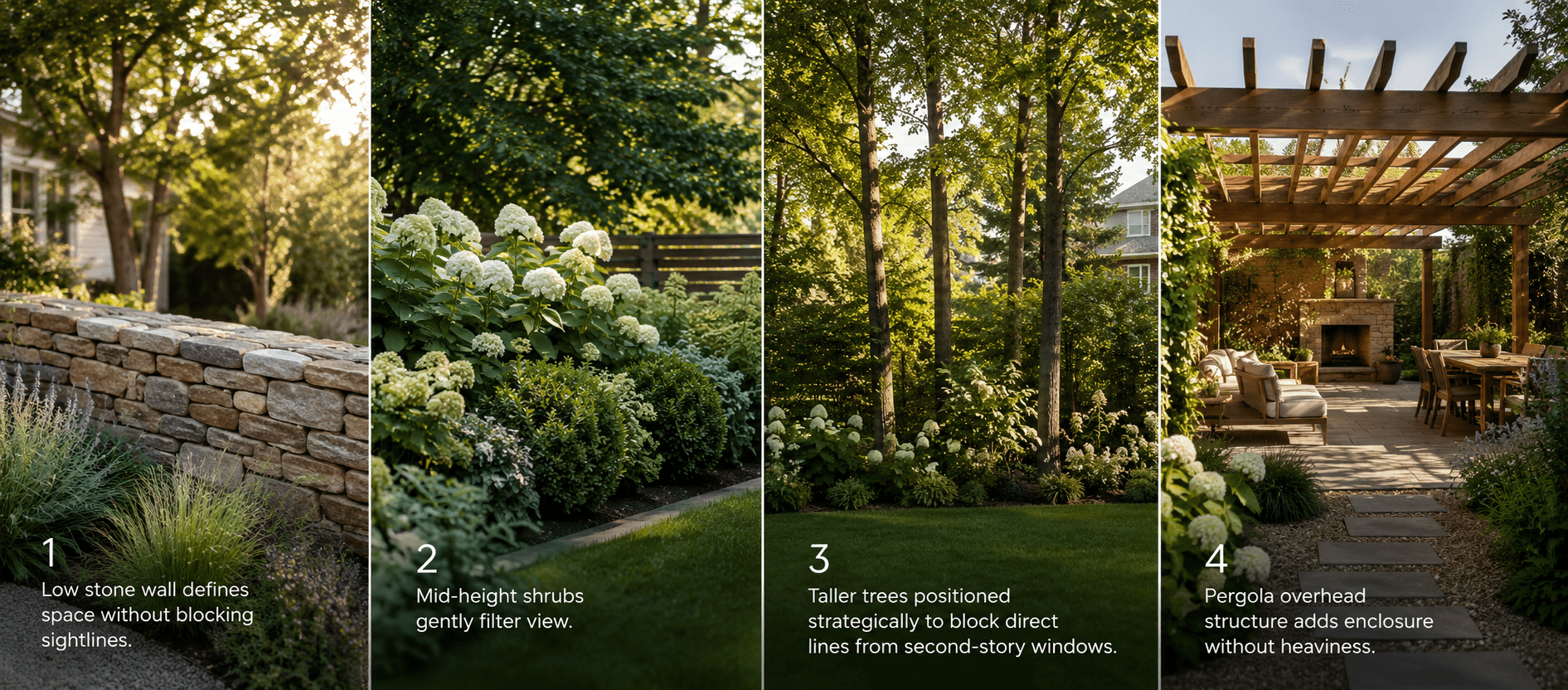
Strategic Planting: The Art of Living Screens
Plants are one of the most powerful tools for creating privacy—but only when used intentionally.
A dense row of identical evergreens might block a view, but it can also feel static and imposing. Living screens, when designed well, feel dynamic, textured, and calming.
Choosing the Right Plant Structure
Effective privacy planting relies on variety in height, density, and seasonal interest.
Consider a mix of:
- Columnar trees for vertical screening without bulk
- Multi-stem small trees for light filtration and movement
- Layered shrubs to soften the base and fill gaps
- Perennials and grasses for seasonal texture and softness
This approach avoids the “green wall” effect and instead creates a natural rhythm.
Case Insight: Filtering vs. Blocking
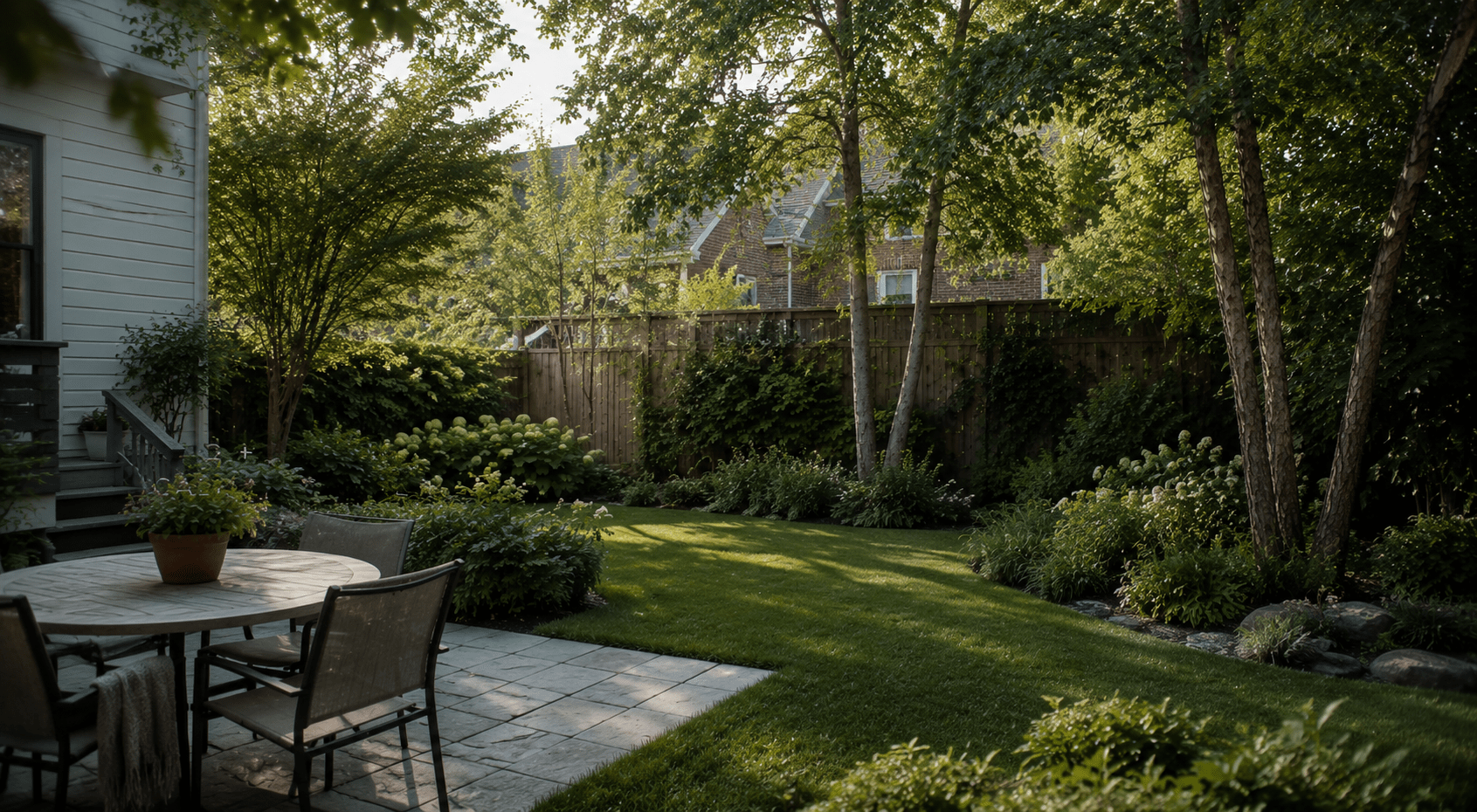
In one recent project, a backyard overlooked by multiple neighboring homes felt exposed from every angle.
Instead of installing a tall fence, we designed a staggered planting plan:
- Tall, airy trees were placed to interrupt direct sightlines
- Mid-level shrubs created visual density at eye level
- Ornamental grasses softened edges and added movement
From inside the space, the result felt open and breathable. From outside, views into the yard were effectively obscured.
Privacy wasn’t achieved by blocking everything—it was achieved by guiding what could be seen.
Screens That Breathe: Architectural Elements That Enhance, Not Enclose
While planting forms the backbone of natural privacy, architectural elements can add structure and clarity.
The key is choosing designs that allow for airflow, light, and visual permeability.
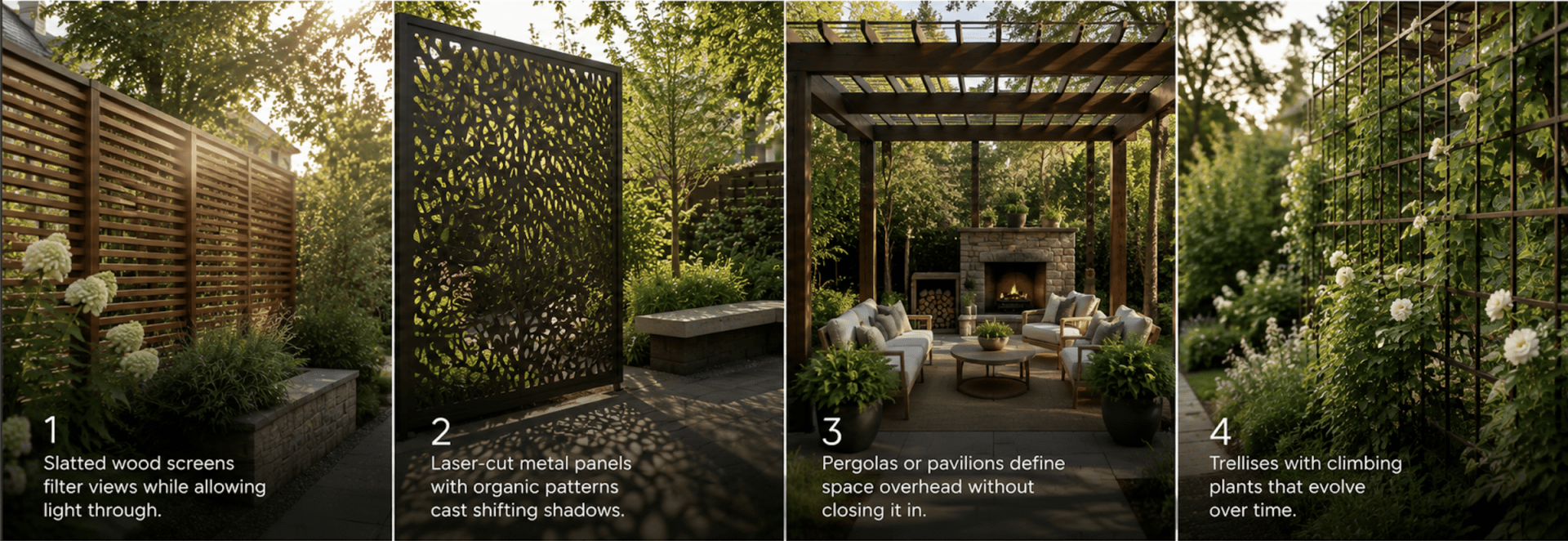
Thoughtful Screen Options
Instead of solid walls, consider:
These elements create a sense of enclosure without rigidity.
Why Permeability Matters
Spaces feel calm when they can “breathe.”
When light filters through a screen, when shadows move across a surface, when glimpses of greenery remain visible—
it keeps the space connected to its surroundings.
This balance is what prevents privacy from becoming confinement.
Designing for Sightlines (Not Just Boundaries)
One of the most overlooked aspects of privacy design is perspective.
Privacy isn’t just about what exists—it’s about what can be seen from specific vantage points.
Start With Key Viewpoints
Ask:
- Where do you spend the most time? (Patio, pool, outdoor dining area)
- Where are neighboring sightlines coming from? (Windows, decks, upper floors)
- What views do you want to preserve? (Trees, sky, garden focal points)
By mapping these perspectives, privacy solutions can be placed precisely where they’re needed—rather than everywhere.
Subtle Redirection
Sometimes, the goal isn’t to block a view entirely—but to redirect attention.
This can be done by:
- Framing a focal point (like a water feature or feature tree)
- Using pathways to guide movement and perspective
- Creating “destination zones” that draw the eye inward
When the eye has somewhere intentional to land, it becomes less aware of what’s beyond.
Sound, Movement, and the Psychology of Privacy
Privacy isn’t purely visual.
A truly secluded space engages multiple senses.
Layering Sound
Even a visually private yard can feel exposed if surrounding noise is constant.
Incorporating sound elements helps:
- Water features mask background noise
- Grasses and leaves create soft, natural movement
- Wind through trees adds a sense of calm
These layers contribute to a feeling of retreat—even in urban or suburban environments.
Movement Creates Comfort
Stillness can feel stark. Movement softens a space.
- Grasses swaying in the wind
- Light shifting through leaves
- Shadows changing throughout the day
These subtle dynamics make a space feel alive—and more forgiving.
Avoiding the “Boxed-In” Effect
The most common mistake in privacy design is overcorrecting.
When every edge is sealed, every gap filled, and every line hardened, the space loses its sense of openness.
Signs a Space Feels Boxed In
- Tall, continuous fencing on all sides
- Uniform hedging with no variation
- Lack of vertical layering
- Minimal light penetration
How to Rebalance
- Introduce variation in height and density
- Open selective sightlines to the sky or distant views
- Replace solid barriers with permeable elements
- Add curves or natural transitions instead of rigid lines
Small adjustments can dramatically shift how a space feels.
A More Natural Kind of Luxury
In today’s landscape design trends, there’s a noticeable shift.
Homeowners are moving away from overly polished, high-maintenance outdoor spaces—and toward environments that feel grounded, natural, and restorative.
Privacy plays a major role in this evolution.
Not as isolation, but as intentional separation.
Not as defense, but as comfort.
A well-designed space doesn’t just protect you from being seen—it gives you permission to fully be.
Designing a Space That Feels Like Yours
Privacy isn’t just about what you keep out. It’s about what you create within. A backyard should feel like an extension of your life—quiet,
comfortable, and deeply personal. When privacy is approached with intention, it enhances that feeling rather than limiting it.
At Quiet Nature, we design outdoor spaces that balance seclusion with openness—layered landscapes that feel natural, breathable, and enduring.
If your backyard feels exposed, or overly enclosed, there’s a better way forward. One that works with nature, not against it.
A space where you can step outside—and finally feel at ease.