
How Natural Swim Ponds Stay Clear:
The Systems Explained in Plain English
Quiet Nature | Natural Swimming Pools & Outdoor Living
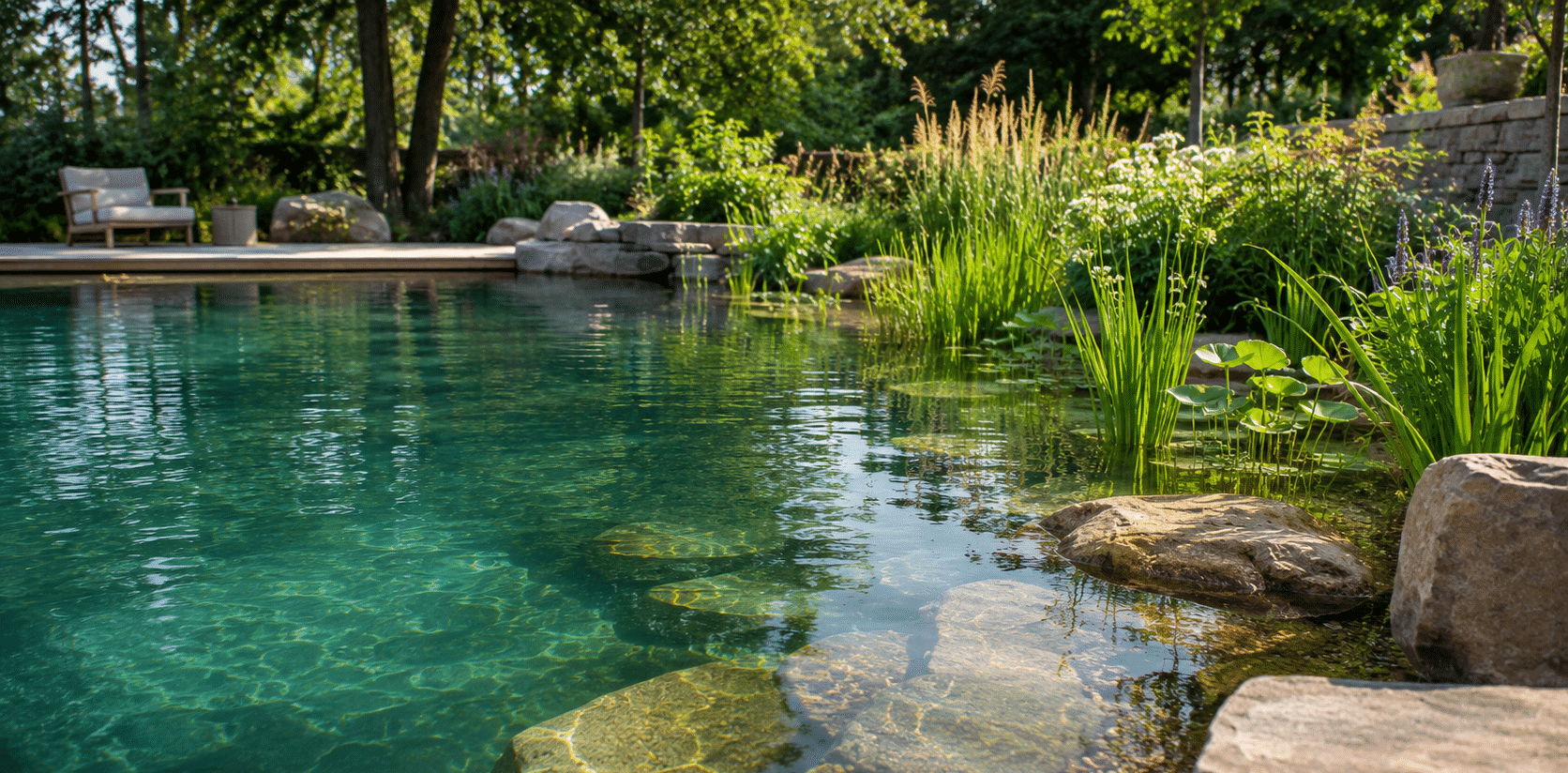
A swimming pool can look beautiful in a photograph. But keeping that water clear, balanced, and inviting throughout the swimming season is where thoughtful design really matters.
Natural swimming ponds take a different approach to water treatment. Instead of relying on conventional chlorine-based sanitation, they use a carefully designed combination of circulation, filtration, beneficial microorganisms, and, in some systems, aquatic plants to maintain water quality.
The result is an outdoor swimming environment that brings together the beauty of a natural pond and the comfort of a thoughtfully designed swimming space.
But how does it actually work? And how can water stay clear when there are no traditional pool chemicals doing the work?
Let’s break down the systems behind natural swim ponds, without getting lost in technical jargon.
What Is a Natural Swimming Pond?
A natural swimming pond is a purpose-built swimming environment that uses biological and mechanical filtration processes to maintain water quality.
Unlike a conventional swimming pool, which typically relies on chemical disinfectants and mechanical filtration, a natural swimming pond is designed around the principles of a living aquatic ecosystem.
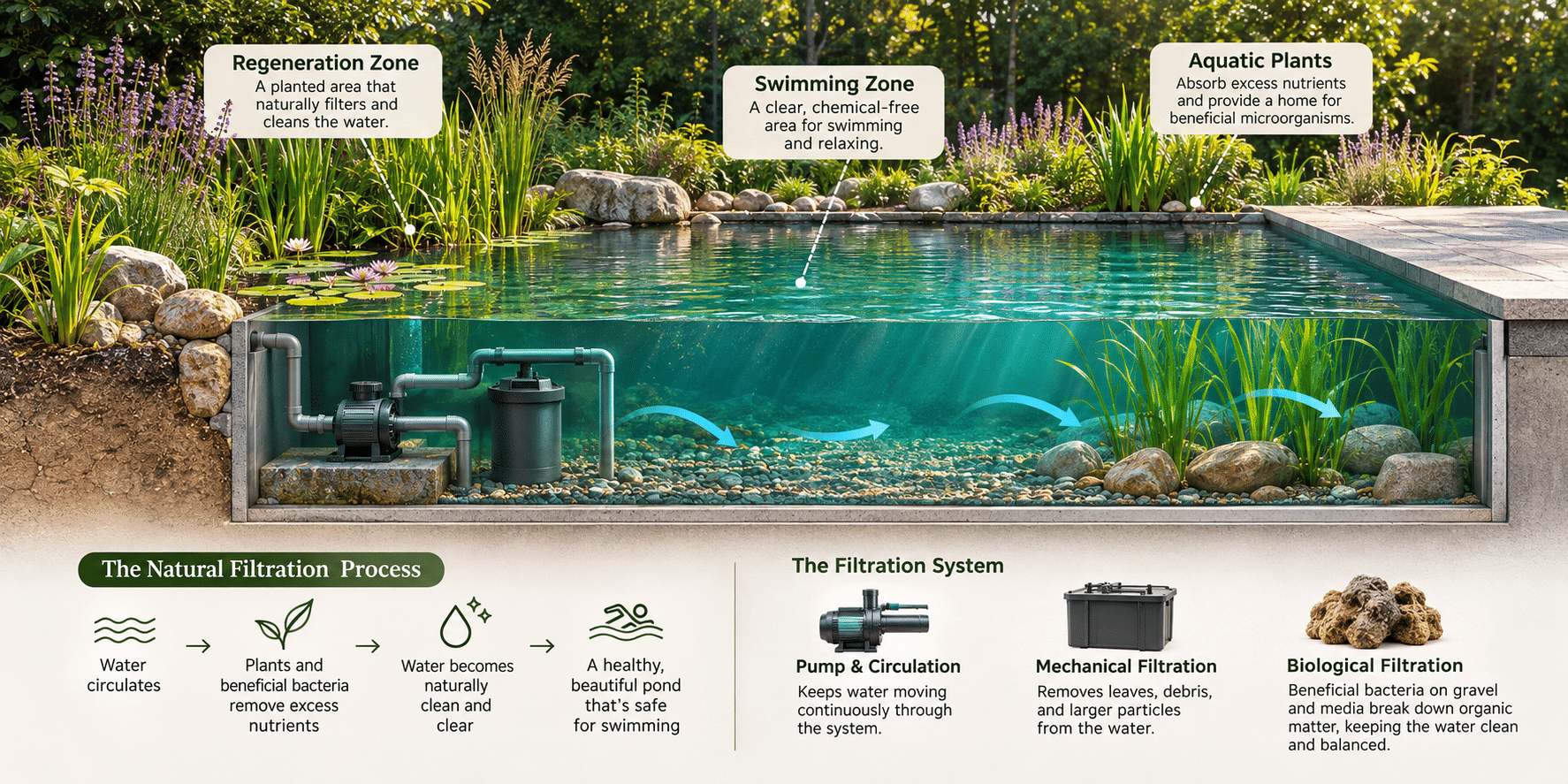
Water moves through a combination of filtration components that help remove debris, process organic matter, and manage nutrients that could otherwise encourage algae growth.
Depending on the design, this may include:
- A dedicated swimming area.
- A regeneration zone containing aquatic plants and filtration materials.
- Mechanical filtration equipment.
- Biological filter beds or dedicated filter chambers.
- Pumps and circulation systems.
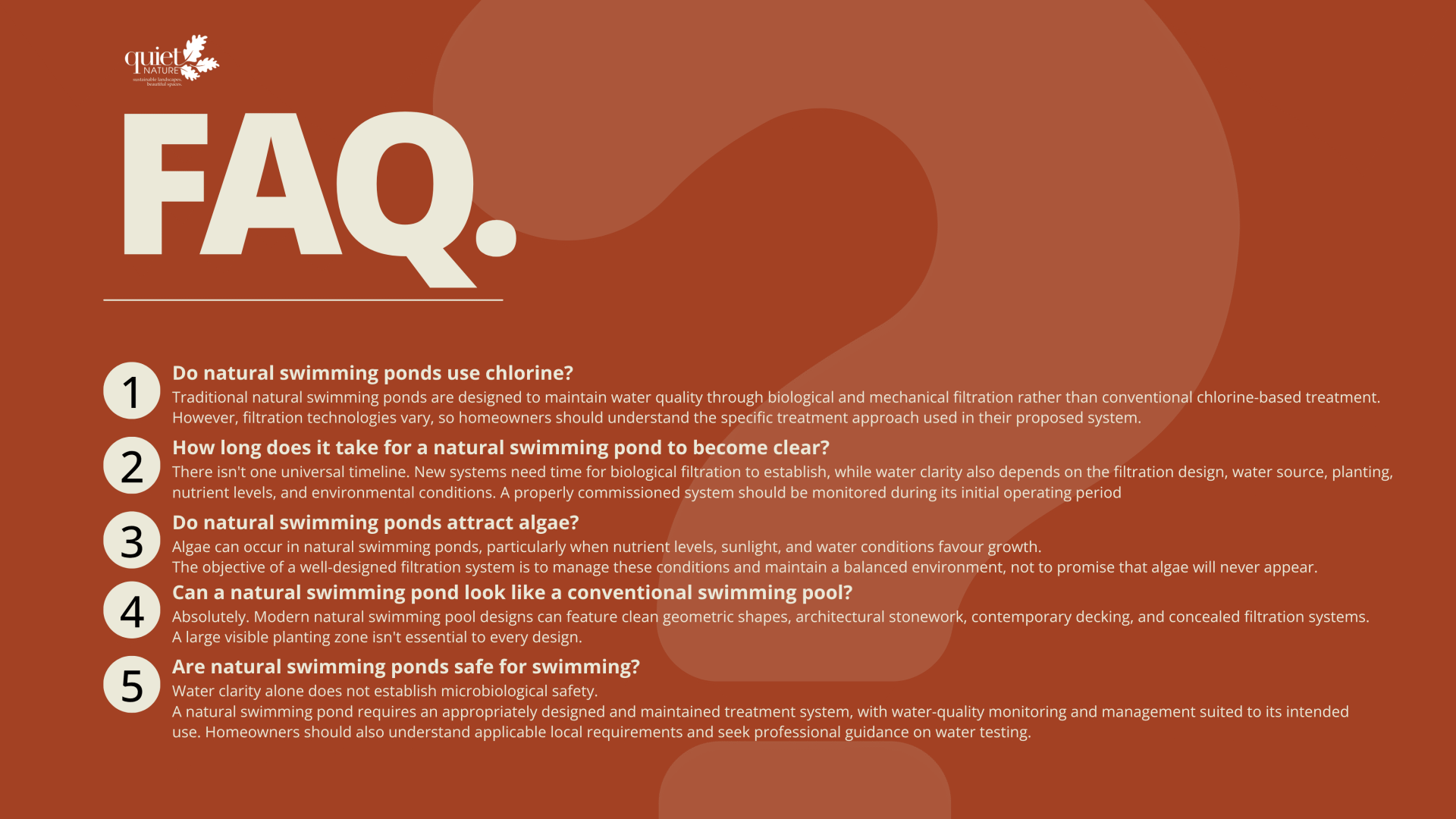
Not every natural swimming pond looks or operates the same way. Some feature expansive planted regeneration zones, while others use more compact, engineered filtration systems that allow the swimming area to resemble a contemporary swimming pool.
The important distinction is that clear water doesn’t happen by accident. It is the result of several systems working together.
How Do Natural Swim Ponds Stay Clear?
The simplest way to understand natural swimming pond filtration is to think of it as a series of cleaning stages.
Each stage has a specific responsibility. Some remove visible debris, others support beneficial bacteria, and some help control excess nutrients.
Here are the main processes involved.
1. Mechanical Filtration: Removing the Visible Debris
The first step is removing unwanted material before it has a chance to break down in the water.
Leaves, grass clippings, pollen, insects, and other organic debris can accumulate on the surface or settle at the bottom of a swimming pond.
If left unattended, this material eventually decomposes and releases nutrients into the water. Those nutrients can contribute to algae growth.
Mechanical filtration helps prevent this from happening.
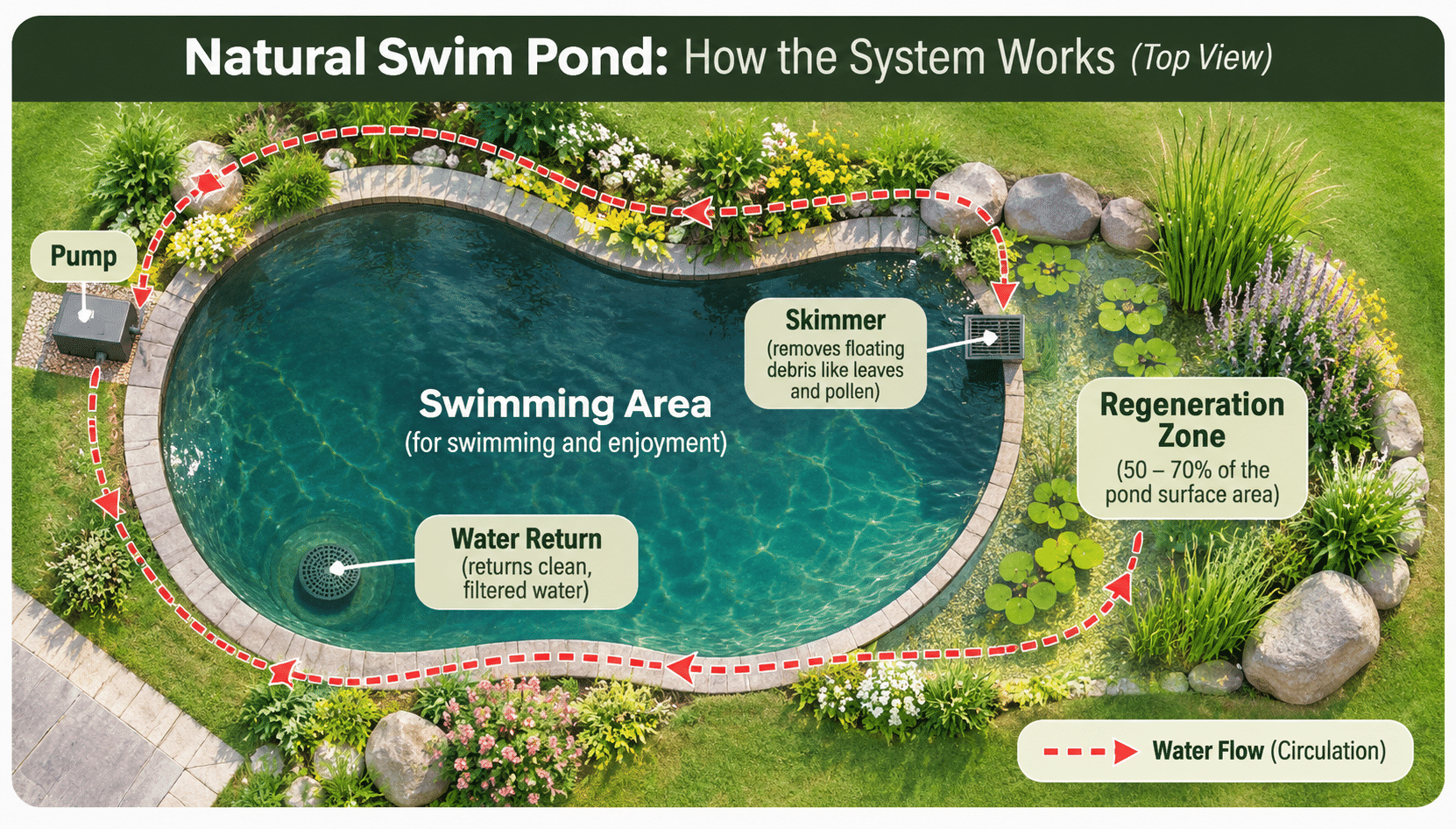
Common components include:
- Surface skimmers: Collect floating leaves, insects, and other debris before they sink.
- Pre-filters: Capture larger particles before water reaches more advanced filtration equipment.
- Bottom drains: Help collect settled debris and direct it toward the filtration system.
- Filter mats or screens: Trap suspended particles as water passes through them.
Think of mechanical filtration as the first line of defence. It removes the physical material that would otherwise place additional pressure on the biological filtration system.
For homeowners, this also explains why regular skimmer maintenance and removing fallen leaves are important parts of natural swimming pond care.
2. Biological Filtration: Letting Beneficial Bacteria Do the Work
This is where things get particularly interesting.
Biological filtration relies on beneficial microorganisms, especially bacteria, that naturally establish themselves on surfaces within the filtration system. These microorganisms form a thin living layer called a biofilm. When water passes through the filter media, the bacteria help process dissolved organic waste and nitrogen-containing compounds.
One important process is called nitrification. Here’s how it works in plain English:
- Organic waste and other sources introduce nitrogen-containing compounds into the water.
- Beneficial bacteria convert ammonia into nitrite.
- Other bacteria convert nitrite into nitrate.
- Plants and other biological processes can then help manage the resulting nutrients.
Why does this matter?
Because an excess of nutrients can encourage algae to multiply. By processing waste and supporting a balanced aquatic environment, biological filtration helps prevent the conditions that make water cloudy or green.
The filtration material itself is important, too.
Gravel, specially selected mineral media, and engineered filter substrates provide surfaces where beneficial bacteria can establish themselves.
The goal isn’t to sterilize the water. It’s to create an environment where the right biological processes can take place.
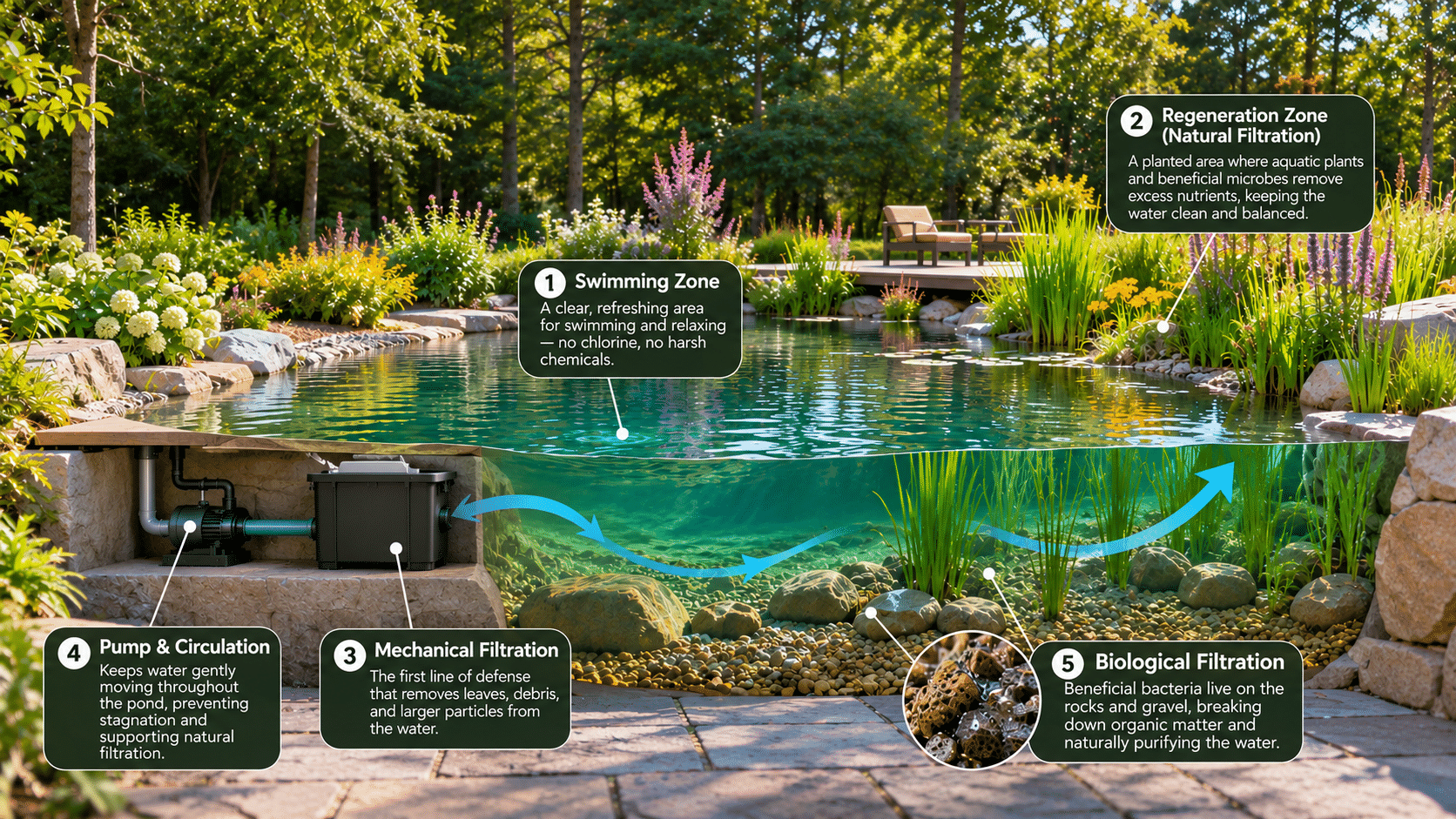
3. The Regeneration Zone: Where Plants Become Part of the Filtration System
One of the most recognizable features of traditional natural swimming ponds is the regeneration zone.
This is a designated area containing aquatic plants, gravel, and other filtration materials. It works alongside the swimming area to support natural water treatment.
But plants aren’t simply there to make the pond look beautiful. They play an important role in nutrient management.
Aquatic plants absorb nutrients, including nitrogen and phosphorus, through their roots and surrounding growing environment. These nutrients are essential for plant growth, but they can also encourage unwanted algae when present in excessive amounts. By incorporating plants into the filtration design,
the system creates another pathway for managing available nutrients.
The roots also provide surfaces for beneficial microorganisms to colonize.
Some common planting choices for appropriately designed regeneration zones include:
- Rushes.
- Sedges.
- Water irises.
- Selected native aquatic plants.
- Other suitable marginal water plants.
Plant selection should always consider the local climate, water depth, growing conditions, and the specific filtration design.
For properties in Waterloo Region and Southern Ontario, seasonal changes are particularly important. Plant performance, leaf fall, and winter dormancy all influence how the regeneration zone behaves throughout the year.
An important distinction: Not every natural swimming pond depends on a large planted regeneration zone. Some modern systems use engineered biological filtration chambers instead, allowing the filtration process to happen largely out of sight.
Both approaches can work when properly designed and sized for the swimming environment.
4. Phosphorus Management: Controlling One of the Main Contributors to Algae Growth
There is another important part of maintaining clear water that often gets overlooked: phosphorus.
Phosphorus is an essential nutrient for plant growth, but excessive amounts can contribute to algae problems.
It can enter a swimming pond through several sources:
- Organic debris such as leaves and grass.
- Soil and runoff entering the water.
- Certain water sources used to fill or top up the pond.
- Decomposing organic material.
- Nutrients introduced by swimmers.
This is why some natural swimming pond systems incorporate specialized mineral filtration media.
Certain materials are designed to bind or adsorb phosphorus as water passes through them, helping reduce the amount available for algae growth.
This process is different from simply trapping visible particles. It targets dissolved nutrients that mechanical filters cannot necessarily remove.
For a well-designed natural swimming pond, phosphorus management is an important consideration because controlling nutrients helps maintain a more stable aquatic environment.
It also highlights why filtration should be considered as a complete system rather than a collection of individual components.
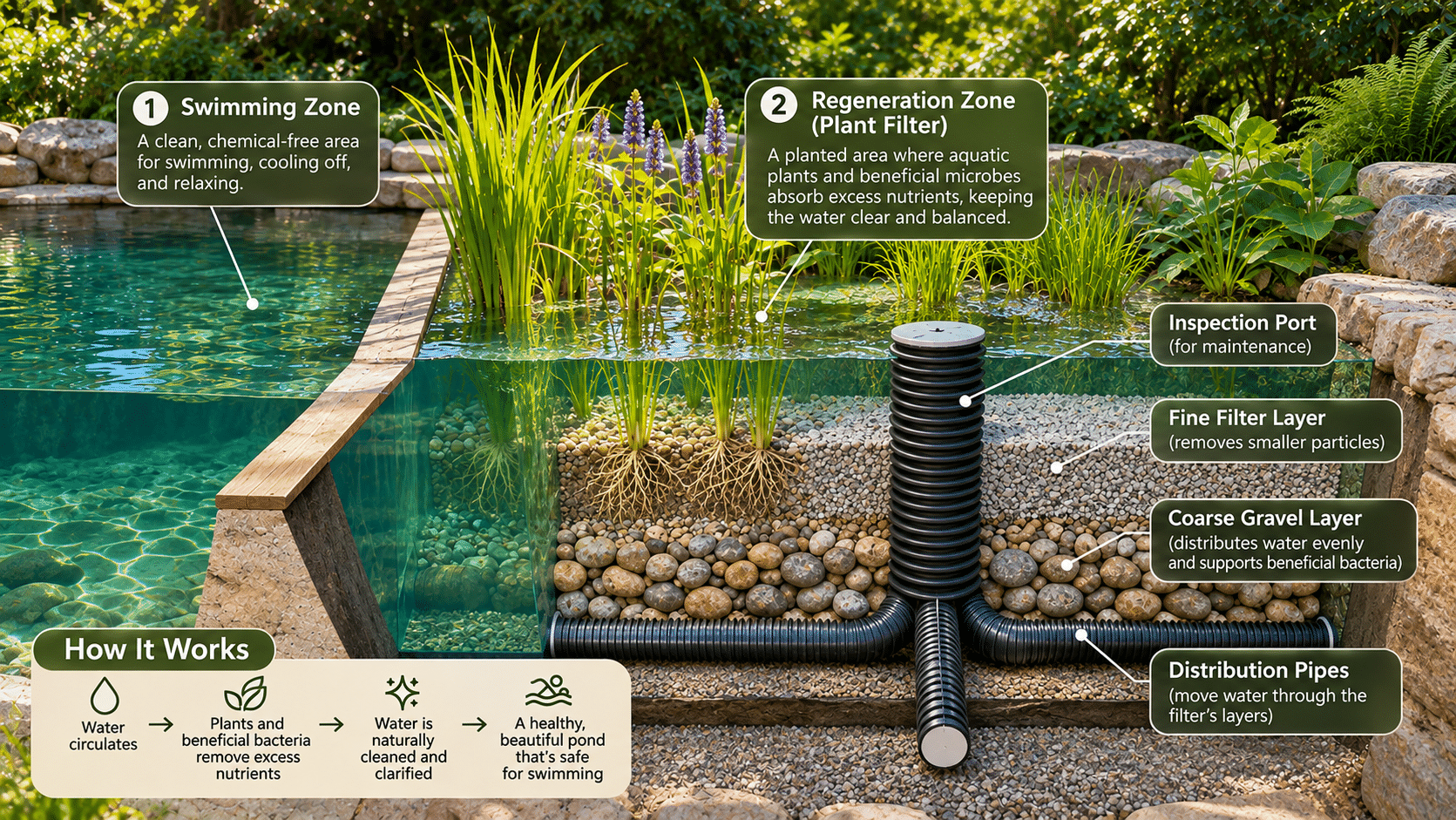
5. Water Circulation: Keeping Everything Moving
Even the best filtration materials won’t perform as intended if water isn’t moving through them properly.
Water circulation connects all the different parts of the system.
Pumps move water from the swimming area through skimmers, filtration chambers, biological filter beds, or regeneration zones before returning it to the pond.
This continuous movement helps:
- Direct floating debris toward skimmers.
- Move suspended particles toward filtration equipment.
- Deliver nutrients and organic compounds to biological filter surfaces.
- Reduce stagnant areas.
- Distribute treated water throughout the swimming environment.
Proper circulation also helps maintain more consistent water conditions.
However, more circulation doesn’t automatically mean better filtration. Pump capacity, flow rates, pipe sizing, filter resistance, and the overall layout must work together.
A system that moves too little water may struggle to maintain consistent conditions. One that is poorly balanced may waste energy without improving filtration performance.
This is why circulation should be engineered around the specific dimensions and filtration requirements of the pond.
How Do the Different Filtration Systems Work Together?
Understanding each component individually is useful, but the real advantage comes from how they work as a complete system.
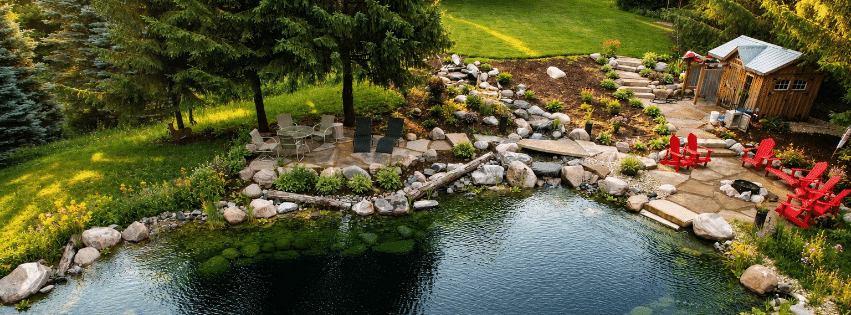
Here’s a simplified example of how water might move through an engineered natural swimming pond:
| Stage | What happens | Why it matters |
| 1. Collection | Skimmers and drains collect debris | Removes organic material |
| 2. Mechanical filtration | Filters capture suspended particles | Reduces physical impurities |
| 3. Biological filtration | Beneficial bacteria process waste | Supports nutrient balance |
| 4. Mineral filtration | Specialized media can bind phosphorus | Helps limit algae-supporting nutrients |
| 5. Regeneration | Plants and biological processes manage nutrients | Supports natural water treatment |
| 6. Return circulation | Treated water returns to the swimming area | Maintains continuous movement |
The exact order and configuration vary between systems. Some processes happen simultaneously, and not every installation includes every component.
The important thing is that each part has a purpose.
A natural swimming pond should be designed around the relationship between water volume, swimming activity, filtration capacity, nutrient loading, and the available space.
Simply adding plants or installing a pump isn’t enough to create a reliable swimming environment.
Why Does a Natural Swimming Pond Sometimes Become Cloudy or Green?
Even a properly designed natural swimming pond can experience changes in water clarity.
A natural filtration system is a living system, which means it responds to environmental conditions, seasonal changes, and how frequently the pond is used.
Some common causes include:
1. Excessive organic debris
Fallen leaves, grass clippings, and other organic material can increase nutrient levels as they decompose.
2. An immature biological filter
Newly installed systems need time for beneficial bacteria to establish themselves. Water conditions may fluctuate while the biological filtration matures.
3. Poor circulation
Inadequate water movement can create areas where debris accumulates and filtration becomes less effective.
4. Excess nutrients
Phosphorus and nitrogen entering the water can encourage algae growth, particularly when combined with favourable sunlight and temperatures.
5. Seasonal changes
Spring pollen, autumn leaves, warmer summer temperatures, and winter dormancy can all affect water conditions.
This is particularly relevant in Southern Ontario, where outdoor water features experience considerable seasonal variation.
The solution isn’t necessarily to add more equipment. Sometimes the issue is an imbalance between the existing filtration system, its maintenance requirements, and the conditions surrounding the pond.
Understanding the cause is the first step toward restoring clarity.
Are Natural Swimming Ponds Difficult to Maintain?
A common misconception is that natural swimming ponds are completely maintenance-free.
While they can reduce the need for conventional pool chemicals, they still require thoughtful care.
The amount of maintenance depends on the design, filtration technology, surrounding landscape, and how frequently the pond is used.
Typical maintenance tasks include:
- Emptying skimmer baskets regularly.
- Removing leaves and organic debris.
- Cleaning or servicing filtration components as recommended.
- Monitoring water conditions.
- Maintaining aquatic plants where applicable.
- Inspecting pumps and circulation equipment.
- Removing accumulated sediment when necessary.
A well-designed system should make these tasks manageable and predictable.
It should also be designed with maintenance access in mind. Filtration chambers, pumps, and other equipment need to be accessible without disrupting the surrounding landscape.
At Quiet Nature, this is an important part of considering a backyard transformation as a complete outdoor living environment, not simply an installation project.
Choosing the Right Natural Swimming Pond Filtration System
Not every backyard has the same requirements.
A property with generous space may accommodate a larger planted regeneration zone. Another homeowner may prefer a more contemporary swimming area
with compact, concealed filtration technology.
The right approach depends on several factors:
Available space: Determines whether a larger regeneration zone or compact engineered filtration system is more suitable.
Swimming area and water volume: Filtration capacity must be appropriate for the size of the pond and its intended use.
Surrounding environment: Trees, gardens, soil conditions, and potential runoff influence the amount of organic material and nutrients entering the water.
Aesthetic preferences: Some homeowners love the appearance of aquatic planting, while others prefer clean architectural lines and a more pool-like swimming experience.
Maintenance expectations: Different systems have different servicing requirements. These should be understood before construction begins.
Technologies such as BioNova filtration systems offer engineered approaches to natural swimming pool water treatment, bringing together specialized filtration components and biological processes.
The key is selecting a system that suits the property rather than trying to make one filtration approach work for every backyard.
A Swimming Environment Designed Around Nature
The beauty of a natural swimming pond isn’t simply the absence of conventional pool chemicals. It’s the thoughtful engineering behind an environment where water, filtration, plants, and microorganisms work together.
From the first skimmer that collects a fallen leaf to the biological filter that processes dissolved waste, every component contributes to the overall health of the water.
And when these systems are properly designed, they create something that goes beyond a place to swim. They become an integrated part of the landscape, bringing movement, texture, and a more connected relationship with the outdoors.
At Quiet Nature, we believe a backyard should be designed with intention, balancing the practical details of water management with the experience of enjoying the space.
Whether you’re considering a natural swimming pond, exploring modern natural pool filtration, or imagining a complete backyard transformation, the right design begins with understanding how everything works together.
Thinking about bringing a natural swimming pond into your backyard?
Quiet Nature works with homeowners across Waterloo Region and Southern Ontario to create thoughtfully designed outdoor spaces, including natural swimming environments that bring together craftsmanship, sustainability, and everyday enjoyment.
Explore Quiet Nature and start imagining what your backyard could become.