
There’s a quiet promise embedded in the phrase “low-maintenance.”
It shows up in Pinterest boards, garden center tags, and landscaping proposals—often paired with images of lush, layered gardens that somehow look effortless.
For many homeowners, it represents a kind of relief: a beautiful outdoor space that doesn’t demand every weekend, every spare hour, every ounce of energy.
But here’s the truth, most people only discover later: Low-maintenance doesn’t mean no maintenance. And more importantly, it doesn’t mean the same thing for everyone.
Understanding what “low-maintenance” actually means is the difference between a landscape that quietly supports your life…
and one that slowly becomes another responsibility you didn’t plan for.
Let’s break it down properly.
What “Low-Maintenance” Really Means
At its core, a low-maintenance planting plan is not about eliminating work. It’s about designing a landscape that works with natural systems instead of constantly fighting them.
That includes:
- Plants that are suited to your soil, climate, and light conditions
- Layouts that reduce ongoing intervention
- Materials and spacing that minimize upkeep over time
A truly low-maintenance garden feels stable. It doesn’t require constant correction. It matures gracefully.
It’s Not About Doing Less—It’s About Doing Things Smarter
Many homeowners think low-maintenance means:
- No pruning
- No watering
- No seasonal cleanup
- No plant replacement
In reality, those expectations lead to disappointment.
Instead, think of it this way:
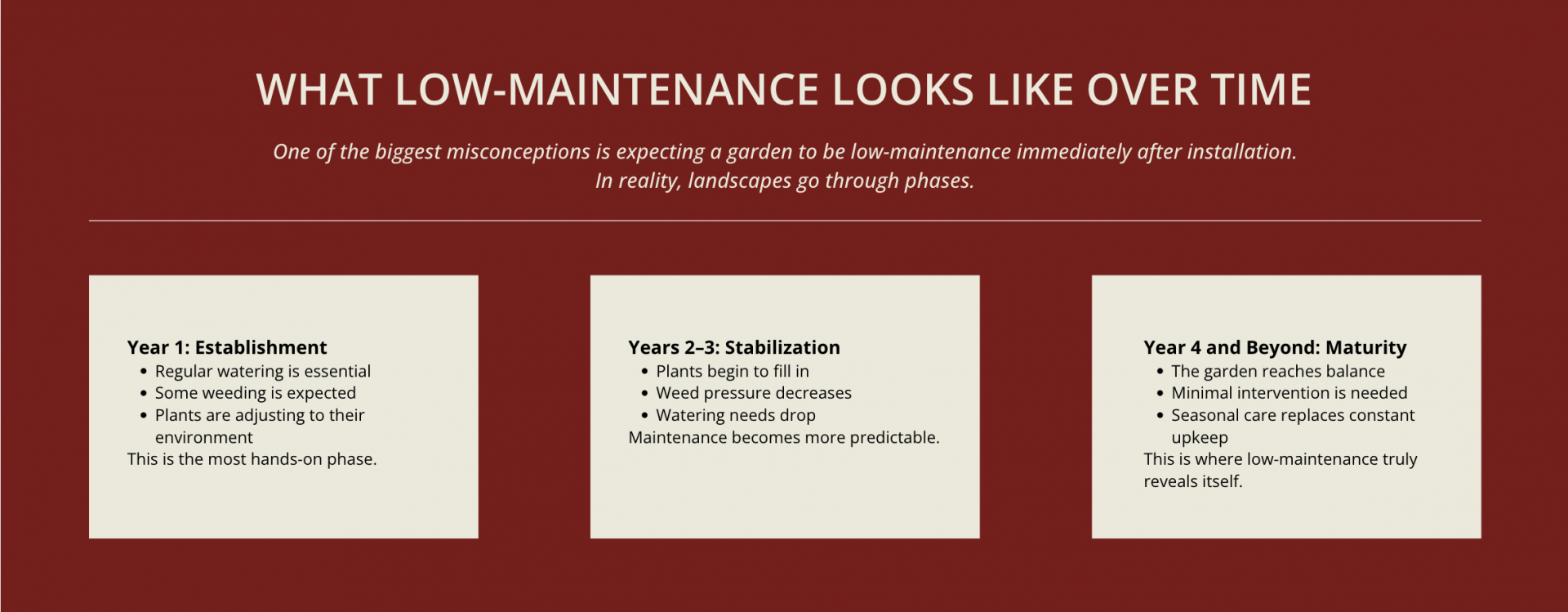
A well-designed low-maintenance garden shifts effort from constant reaction to intentional, occasional care.
You might still prune—but far less frequently.
You might still weed—but not endlessly.
You might still water—but not every day.
Why “Low-Maintenance”
Often Fails in Real Life
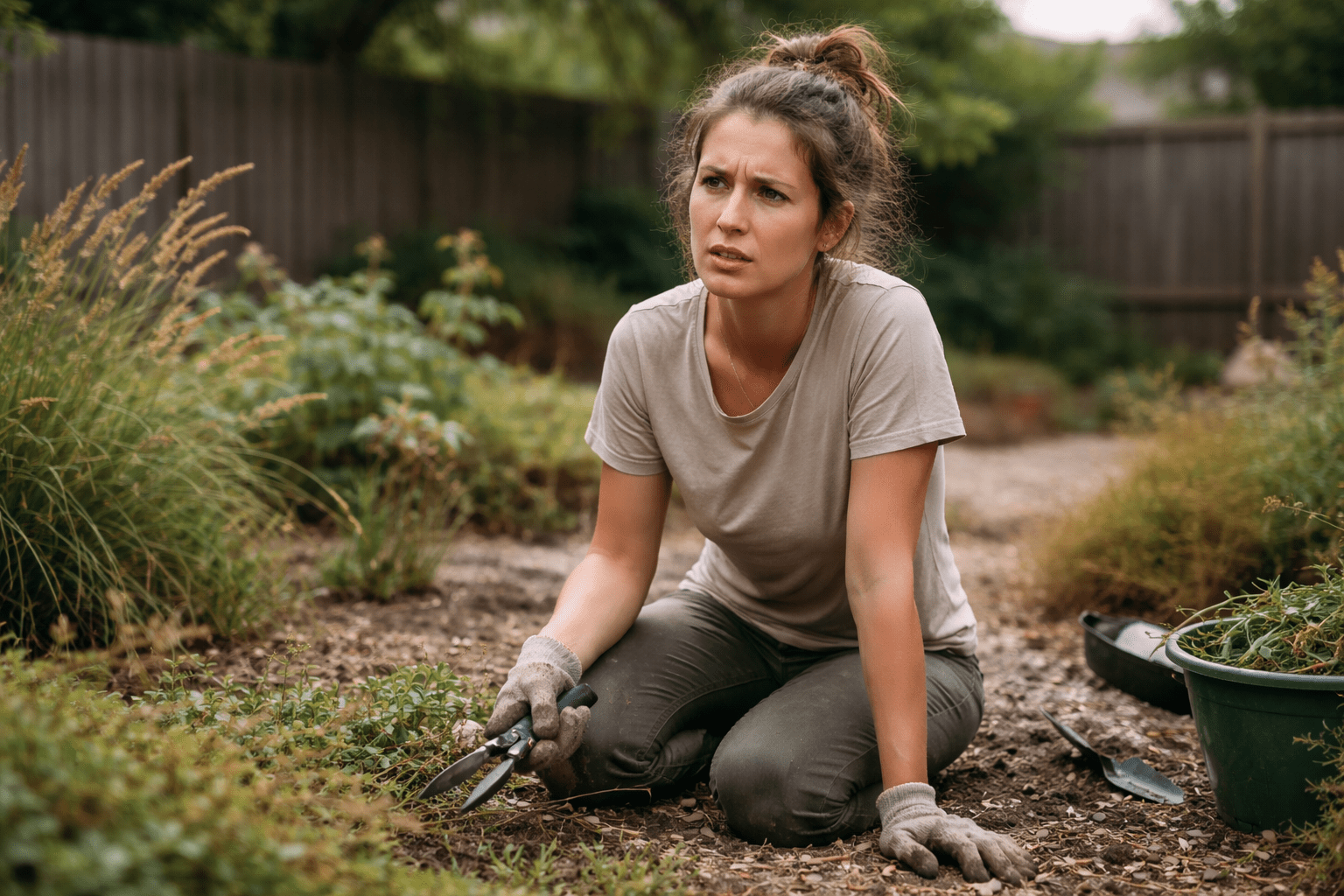
If you’ve ever planted something labeled “easy care” only to watch it struggle, you’re not alone.
The issue is rarely the plant itself. It’s usually the context it’s placed in.
Common Reasons Low-Maintenance Gardens Become High-Maintenance
1. Mismatch Between Plant and Environment
A drought-tolerant plant placed in heavy clay soil can fail quickly. Likewise, a moisture-loving plant in fast-draining soil will constantly struggle.
The result? More watering, more replacement, more frustration.
2. Overcrowding at Installation
New gardens often look full and lush right away—but plants grow.
When spacing is ignored:
- Airflow decreases
- Disease risk increases
- Pruning becomes constant
What was meant to feel abundant becomes overwhelming.
3. Over-Reliance on Mulch Alone
Mulch is often treated as the solution to everything.
While it helps with:
- Moisture retention
- Weed suppression
…it’s not a substitute for proper planting design. Without the right plant density and layering, weeds still find their way in.
4. Ignoring Soil Conditions
In regions with dense clay soil—like much of the Waterloo area, where many Quiet Nature projects are based—drainage plays a critical role.
Poor soil planning leads to:
- Root rot
- Stunted growth
- Ongoing plant replacement
Which is the opposite of low-maintenance.
Real-Life Scenario: Two Approaches, Two Outcomes
Consider two homeowners with similar-sized backyards.
Homeowner A: Quick-Fill Approach
- Dense planting for instant fullness
- Mixed plant types with varying needs
- Minimal soil preparation
Result after 2 years:
- Overgrown beds
- Constant pruning
- High plant turnover
Homeowner B: Intentional Low-Maintenance Design
- Proper spacing
- Soil improvement upfront
- Cohesive plant palette
Result after 2 years:
- Balanced growth
- Reduced weeding
- Minimal intervention
The difference isn’t effort—it’s design.
Practical Strategies for Homeowners
If you’re aiming for a low-maintenance planting plan, here are grounded, realistic ways to approach it:
Focus on Long-Term Efficiency
Ask:
- Will this plant outgrow its space?
- Does it match my soil and light conditions?
- How will this area look in 3–5 years?
Reduce Lawn Where It Doesn’t Serve You
Lawns are often the highest-maintenance element in a yard.
Replacing underused lawn areas with:
- Planting beds
- Naturalized spaces
- Groundcovers
…can significantly reduce upkeep.
Use Hardscape Strategically
Paths, patios, and defined edges:
- Reduce planting area
- Improve accessibility
- Minimize maintenance zones
Plan for Seasonal Simplicity
Choose plants that:
- Don’t require frequent deadheading
- Maintain structure through winter
- Provide multi-season interest
This reduces the need for constant attention.
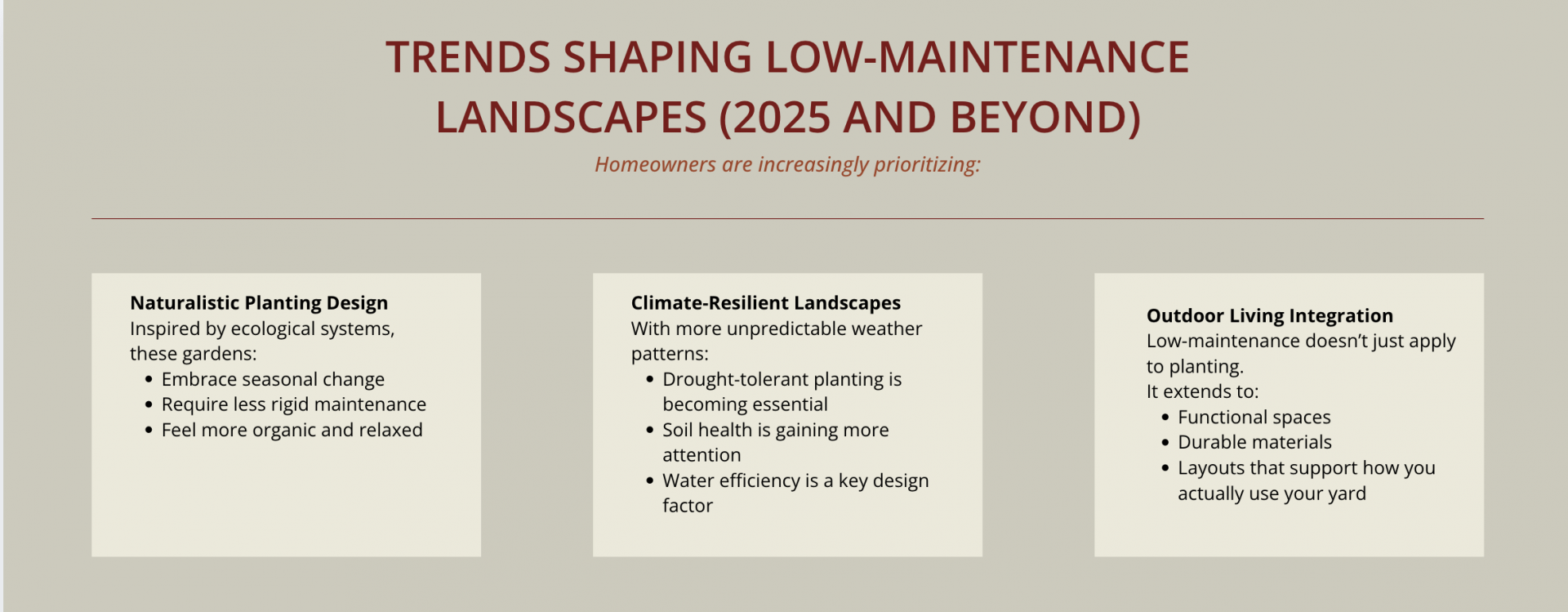
A Different Way to Think About Your Landscape
A low-maintenance garden isn’t about removing effort entirely, but about creating a space that gives more than it takes. It’s a place where growth feels natural rather than forced, where care becomes occasional instead of constant, and where beauty evolves instead of demanding perfection. At Quiet Nature, the goal is never just to make something look good on day one—it’s to design landscapes that settle in, soften with time, and quietly support the way you live without asking for more than they should. If you’re thinking about transforming your outdoor space, the conversation goes beyond how it will look—it’s about how it will feel to live with it every day.