
Swim Pond vs. Traditional Pool:
What’s the Difference?
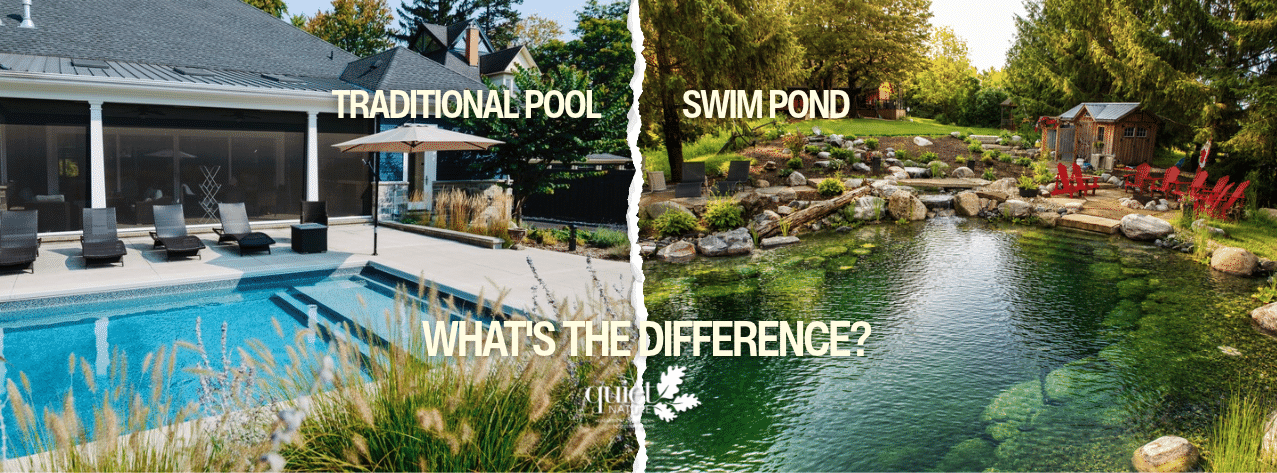
A swimming pool gives you a place to cool off on a warm summer afternoon. A swim pond offers something a little different: the opportunity to swim in water that
feels connected to nature, surrounded by planting, stone, and a thoughtfully designed landscape.
For homeowners considering a backyard transformation, the decision between a natural swim pond and a traditional swimming pool goes beyond appearance.
It involves how you want to use your outdoor space, how much maintenance you’re comfortable with, what kind of water treatment you prefer,
and what you want your property to offer over the long term. Both options can create a beautiful place to swim and spend time with family.
But they offer very different ownership experiences. So, which is right for your backyard?
Let’s explore the differences between a swim pond and a traditional pool, including water quality, maintenance, chemicals, operating considerations, and the long-term value of each.
1. The Swimming Experience: A Backyard Pool or a Natural Retreat?
The most noticeable difference between a traditional swimming pool and a natural swim pond is how each one feels within the landscape.
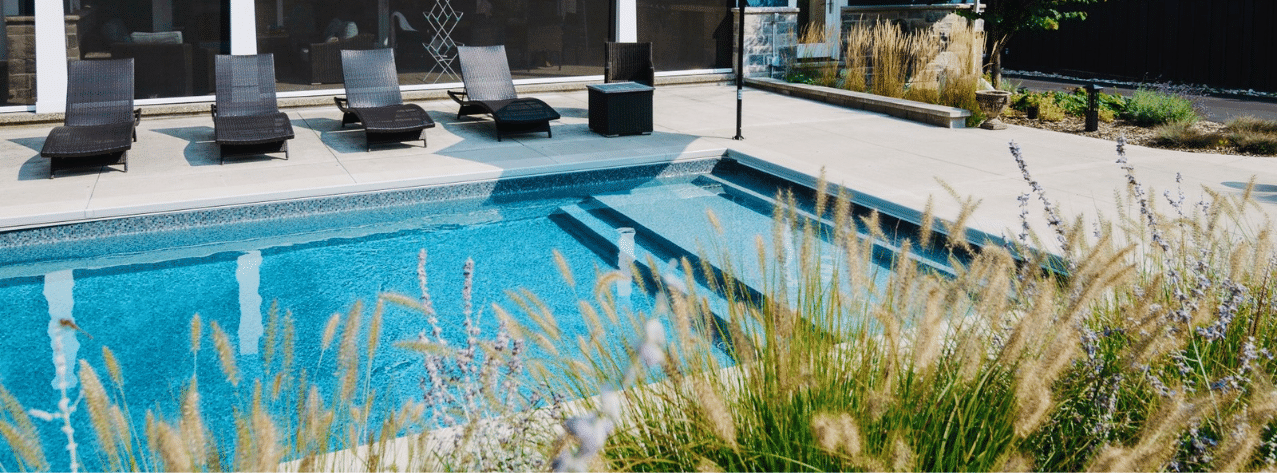
A traditional pool is designed primarily for swimming and recreation. Its clean lines, defined edges, uniform depth, and clear blue water create a familiar, polished environment. It works
particularly well for homeowners who enjoy swimming laps, hosting pool parties, or having a dedicated recreational space.
A natural swim pond takes a more integrated approach. Rather than treating the swimming area as a separate feature, it becomes part of the overall garden design.
Imagine stepping outside to find a natural-looking body of water framed by ornamental grasses, flowering perennials, natural stone, and carefully selected aquatic plants. Instead of looking at a pool surrounded by a deck, you’re looking at a landscape that happens to invite you for a swim.
A natural swim pond can offer:
- A more organic appearance that complements the surrounding garden.
- A swimming environment without the traditional chlorine smell.
- Opportunities to incorporate waterfalls, stone features, and aquatic planting.
- A quieter, more immersive connection with the outdoors.
- A landscape feature that can be enjoyed even when nobody is swimming.
This is particularly appealing to homeowners who want their backyard to feel like an extension of their home rather than a dedicated pool area.
The distinction comes down to lifestyle. If swimming laps and structured recreation are your priorities, a traditional pool may be the better fit. If you envision a backyard retreat that combines swimming, relaxation, and natural beauty, a swim pond offers a different kind of experience.
2. Water Quality: How Does a Swim Pond Keep Its Water Clean?
One of the biggest questions homeowners have about natural swimming ponds is how the water stays clean without conventional chlorine treatment.
The answer is biological filtration.
Traditional pools typically rely on mechanical filtration and chemical disinfection to maintain water quality. Chlorine or another approved disinfectant helps control harmful microorganisms, while pumps and filters remove suspended particles and debris.
Natural swimming ponds use a different water-treatment approach. They combine physical filtration with biological processes to manage nutrients and maintain water clarity.
How biological filtration works
A properly designed swim pond typically includes two interconnected areas:
The swimming zone
This is the designated area for swimming. It is designed to provide a comfortable recreational space, with appropriate depth, circulation, and access.
The regeneration or filtration zone
This area supports the biological processes that help maintain water quality. Depending on the system, it may contain aquatic plants, specialized filtration media, and beneficial microorganisms. As water circulates through the filtration system, physical and biological processes help remove suspended material and manage nutrients that could otherwise contribute to excessive algae growth.
Aquatic plants can also play an important role by absorbing nutrients from the water. Beneficial microorganisms contribute to the breakdown and processing of organic matter.
Research published in the journal Water in 2023 describes natural swimming ponds as an application of treatment wetlands, using plant-based nutrient uptake, biological filtration, and physical filtration processes to support water purification.
The important distinction is that a swim pond isn’t simply a hole filled with water and surrounded by plants. Its water quality depends on a carefully engineered relationship between circulation, filtration, nutrient management, and the surrounding environment.
3. Chemicals: Is a Natural Swim Pond Really Chemical-Free?
For many homeowners, one of the most appealing aspects of a natural swim pond is the reduced reliance on conventional pool chemicals.
Traditional swimming pools commonly use chlorine or bromine to disinfect water. These treatments are essential to managing harmful microorganisms and maintaining safe swimming conditions when used correctly.
However, chemical treatment also requires ongoing attention.
Pool owners need to monitor disinfectant levels and pH, adjust water chemistry, and follow proper chemical storage and handling procedures.
According to the U.S. Centers for Disease Control and Prevention (CDC), residential pool owners should routinely test chlorine and pH levels. The recommended pH range for conventional pools is 7.0–7.8, with appropriate chlorine levels maintained according to the treatment system being used.
Natural swim ponds generally take a different approach.
Instead of relying on a conventional chlorine or bromine residual, they use biological filtration and carefully managed water circulation to maintain water quality.
This means homeowners can enjoy swimming without the routine addition of conventional pool disinfectants.
But there’s an important distinction worth understanding: chemical-free does not mean maintenance-free or completely free of microorganisms.
Natural swim ponds are living water systems. They require thoughtful design, regular observation, and appropriate water-quality management.
They also aren’t sterile environments. Their water-treatment approach is fundamentally different from that of a conventionally disinfected pool, so homeowners should understand the system’s water-quality protocols and intended use. For families considering either option, it’s worth discussing how water quality is monitored, what testing is recommended, and what safety measures are incorporated into the design.
4. Maintenance: Which Requires More Work?
Maintenance is often where homeowners begin comparing the practical realities of owning a swim pond versus a traditional pool.
The truth is that both require regular care. The difference lies in what you’re maintaining.
Traditional pool maintenance
A conventional pool requires consistent attention to water chemistry and mechanical equipment.
Typical maintenance includes:
- Testing chlorine, pH, and other relevant water chemistry levels.
- Adding treatment products when necessary.
- Skimming leaves and debris from the water.
- Brushing pool walls and floors.
- Cleaning or backwashing filters as required.
- Maintaining pumps, heaters, and circulation equipment.
- Winterizing the pool and preparing it for seasonal opening.
The frequency of maintenance depends on pool size, weather, usage, and the type of filtration and sanitation equipment installed.
For example, a pool surrounded by mature trees may collect more leaves and organic debris, requiring additional skimming and cleaning.
Natural swim pond maintenance
A natural swim pond has its own maintenance requirements, many of which are connected to keeping the biological system balanced.
Typical tasks may include:
- Removing leaves and floating debris.
- Skimming the swimming area.
- Cleaning mechanical filters and skimmers.
- Inspecting pumps and circulation equipment.
- Managing aquatic plant growth.
- Removing accumulated sediment when necessary.
- Monitoring water clarity and overall system performance.
- Preparing the pond for seasonal changes.
The amount of maintenance depends on the design, filtration technology, planting scheme, surrounding landscape, and level of use.
For example, a swim pond surrounded by deciduous trees may require more frequent leaf removal in autumn. If leaves are left to accumulate,
their decomposition can introduce additional nutrients into the water and affect water quality.
Likewise, aquatic plants need occasional management to prevent excessive growth and maintain the intended balance of the regeneration zone.
The biggest difference?
Traditional pools require ongoing attention to chemical balance and sanitation. Natural swim ponds require attention to biological balance, filtration, and the surrounding ecosystem.
Neither is entirely hands-off. A well-designed system simply makes the maintenance process more predictable and manageable.
5. Long-Term Ownership: Looking Beyond the Initial Installation
Choosing between a swim pond and a traditional pool is also a long-term investment decision.
The initial installation cost is important, but it shouldn’t be the only consideration. Homeowners should also think about ongoing operating expenses,
equipment replacement, seasonal care, and how the feature will function within the property over time.
Operating costs
Traditional pools can involve recurring expenses for:
- Chlorine, pH adjusters, and other treatment products.
- Electricity for pumps and filtration systems.
- Heating, if applicable.
- Filter cleaning and replacement.
- Repairs and seasonal maintenance.
Natural swim ponds also have operating expenses, including electricity for circulation pumps, mechanical filtration, occasional equipment replacement,
and professional maintenance when needed.
A biological filtration system may reduce the need for conventional pool chemicals, but it still relies on properly functioning equipment and ongoing care.
It would be misleading to say that every swim pond costs less to operate than every traditional pool. The actual difference depends on the size of the installation,
system design, energy requirements, heating preferences, and maintenance arrangements.
Longevity and equipment
Both systems can provide many years of enjoyment when properly designed and maintained.
For a traditional pool, long-term considerations may include liner replacement, surface refinishing, pump repairs, plumbing, and filtration equipment upgrades.
For a swim pond, considerations include the integrity of the waterproofing, pump and filtration performance, circulation design, and the continued health
of the biological filtration system.
A properly designed swim pond should also account for future plant growth, sediment management, and seasonal changes.
The quality of the original design and installation plays a significant role in avoiding unnecessary complications later.
6. Seasonal Changes: What Happens During an Ontario Winter?
For homeowners in Waterloo Region and Southern Ontario, seasonality is an important part of the decision.
Both traditional pools and natural swim ponds need to be designed with Ontario’s changing weather conditions in mind.
Traditional pools are generally closed for winter. This involves preparing the plumbing and equipment, managing water levels, protecting the pool, and following the manufacturer’s winterization recommendations.
Natural swim ponds also require seasonal preparation, but their management may look different.
Depending on the system, winter preparation can include:
- Adjusting circulation equipment according to the system design.
- Protecting pumps and exposed plumbing from freezing.
- Removing excess organic debris before winter.
- Managing aquatic plants appropriately.
- Monitoring water levels and overall pond conditions.
Some natural swim ponds can remain visually appealing throughout winter, even when swimming is no longer practical.
In fact, this is one of their distinctive advantages as landscape features. The water, stonework, surrounding trees, and winter garden
can continue contributing to the property’s appearance long after swimming season ends.
A swim pond isn’t necessarily a feature that disappears from the backyard when summer is over.
7. Design Flexibility: Which Adds More to Your Landscape?
A traditional pool can be beautifully integrated into a backyard, especially when paired with thoughtful paving, outdoor lighting, planting, and entertaining areas.
However, a swim pond offers particularly interesting opportunities for landscape design because the surrounding environment is an essential part of the experience.
Rather than designing the garden around a pool, the water feature and landscape can be planned together.
Consider a backyard with:
- A natural swimming area surrounded by stone coping.
- A regeneration zone with carefully selected aquatic plants.
- A cascading waterfall that introduces movement and sound.
- Natural stone pathways connecting the swimming area to the garden.
- Layered planting that provides privacy and seasonal interest.
- An outdoor lounge or dining area overlooking the water.
The result is a more comprehensive outdoor living environment.
Another advantage is that the design can be tailored to the character of the property. A swim pond can feel contemporary and architectural, or
more organic and informal, depending on the homeowner’s preferences.
This makes it particularly suitable for homeowners who want their backyard to function as more than a swimming space.
8. Swim Pond vs. Traditional Pool: A Side-by-Side Comparison
Here’s a quick overview of the differences:
| Featured | Natural Swim Pond | Traditional Pool |
| Water treatment | Biological and physical filtration | Chemical disinfection and mechanical filtration |
| Chlorine | Generally not required | Commonly used |
| Appearance | Natural, landscaped environment | Defined, structured swimming area |
| Maintenance focus | Biological balance, plants, filtration | Water chemistry, cleaning, filtration |
| Plant life | Often incorporated into the design | Usually separate from the pool |
| Water quality | Managed through filtration and biological processes | Managed through disinfection and filtration |
| Seasonal care | System-specific winter preparation | Conventional pool winterization |
| Design flexibility | Strong integration with natural landscaping | Wide range of architectural styles |
| Long-term costs | Dependent on design, equipment, and upkeep | Dependent on design, equipment, heating, and upkeep |
Neither option is automatically better. The right choice depends on the experience you want, your property’s characteristics, and the level of maintenance you’re prepared to manage.
9. Which Is Right for Your Backyard?
Before deciding, consider how you imagine spending time outdoors.
A traditional pool may be right for you if:
- You prioritize swimming laps and recreational swimming.
- You prefer a conventional, clearly defined pool design.
- You want an established chemical sanitation approach.
- You don’t want aquatic planting incorporated into the swimming environment.
- You enjoy a more structured poolside setting.
A natural swim pond may be right for you if:
- You want a backyard that feels connected to nature.
- You prefer to avoid routine chlorine or bromine treatment.
- You appreciate natural stone, aquatic plants, and layered landscaping.
- You want a water feature that remains visually interesting throughout the year.
- You’re interested in creating a complete outdoor living environment rather than simply installing a swimming pool.
There’s also an important consideration that homeowners sometimes overlook: the size and character of the property.
A successful swim pond requires space for both the swimming area and the filtration system. The available space, soil conditions, grading, sunlight,
existing trees, and surrounding landscape all influence what can realistically be designed.
This is why a site assessment and a well-developed landscape plan are important before committing to either option.
A Backyard That Offers More Than a Place to Swim
Ultimately, the decision between a swim pond and a traditional pool comes down to what you want your outdoor space to become.
A traditional pool offers a familiar and enjoyable place to swim, exercise, and entertain. A natural swim pond introduces another dimension: a living landscape
where swimming, nature, and outdoor living come together.
For some homeowners, the appeal isn’t simply having somewhere to cool off during summer. It’s stepping outside in the morning, enjoying the sound of moving water, watching the garden change with the seasons, and having a space that feels genuinely restorative.
At Quiet Nature, we believe the best outdoor spaces are designed around how people want to live, relax, and connect with their surroundings.
Whether you’re considering a natural swimming pond or planning a complete backyard transformation, the first step is understanding what your property can offer.
If you’re dreaming of a backyard that brings together beautiful landscaping, thoughtful design, and a more natural swimming experience, we’d love to explore the possibilities with you.
Let’s create an outdoor space worth coming home to.